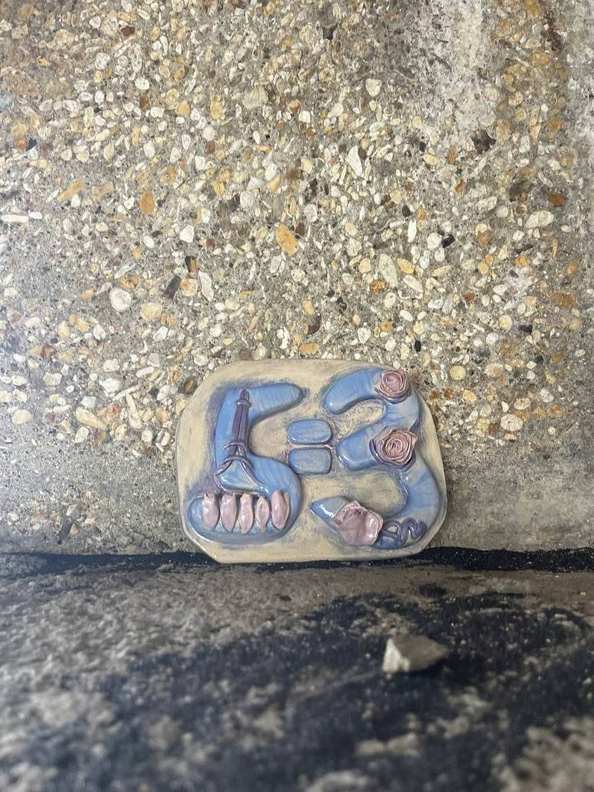
In May 2024, a single hand-cut, glazed ceramic shard went up on a wall in Paris. It carried nothing but the formula, 5=3, and a small QR code in the corner. No plaque next to it explaining what the numbers meant. No name attached. No date. It was placed quietly, the way you might leave a note for a stranger you'll never meet, and then we walked away and let the city do whatever it does with things left on its walls.
That first piece didn't happen entirely on its own. My husband was the one who actually placed it — I'd made the shard, glazed it, fired it, but it was his hands that fixed it to the wall in Paris while I stood nearby. I still think about that division of labor: I made the object out of my own history, and he was the one willing to walk it out into the world and let it go. He'd been present for both of the pregnancies that don't show up in the "3," and he was present for this too, in a much smaller and stranger way — gluing a piece of fired clay to a wall in a city that had nothing to do with either loss.
Why start with nothing explained
I could have started the project with a plaque that spelled everything out — a paragraph about missed miscarriage, a line about who I was, contact information, a call to action. Instead the first piece said only 5=3. Partly that was practical: a single shard doesn't have room for an essay. But mostly it was deliberate. I wanted the first thing anyone encountered to be the bare formula, with no framing at all, so that whatever they made of it would be entirely their own. Someone walking past with no context might read it as decoration, or a puzzle, or nothing at all. Someone who has quietly done that subtraction in their own life would read it immediately, correctly, without needing a caption.
The first plaque said only 5=3 — no name, no explanation, just a formula and a QR code, left on a wall in Paris.
Paris wasn't chosen for any symbolic reason connected to loss. It was simply where we were, where the idea had finally moved from something private into something I could hold in my hands and hand to someone else — and it's a city I've returned to since, including one weekend that took in Luxembourg too. I'd been carrying the numbers 5 and 3 for years before that — they were old facts about my own life, not new ones — but turning them into an object that could exist independently of me, on a wall, for anyone to find, took much longer to work up to than making the object itself.
What came after the first piece. I didn't know, standing in Paris in May 2024, whether there would be a second plaque, let alone a project. What happened next surprised me: within two months there were two plaques in Vienna on the same day, one plain like the Paris piece and one that actually explained, in a few words, what a missed miscarriage is — because by then I understood that some cities, some walls, needed a little more context than others. From there it kept moving. Georgia in the autumn, unexpectedly personal in ways I hadn't fully planned for. A friend who placed a piece entirely on her own initiative, without me anywhere nearby, which told me the idea had become bigger than something only I could carry.
Looking back at that first Paris shard now, after plaques in more than twenty cities, I'm struck by how little has actually changed about the core gesture. The materials have evolved — ceramic gave way to cast porcelain, then to street posters, then to a set of free stickers — but the instinct behind the very first piece is the same one behind all the others: leave the formula somewhere public, say nothing more than the numbers require, and trust that whoever needs to see it will understand exactly what it means, faster than any explanation could manage.
Your numbers matter too
Write down your own X = Y in solidarity, download the free stickers, or ask us to send a plaque to your city.
Share your numbers