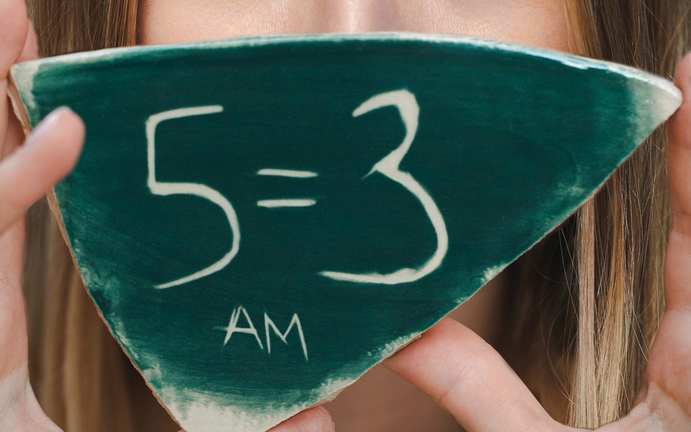
People ask me the same question in almost every city: what does it mean? Sometimes they ask it out loud, standing in front of a small ceramic plaque on a wall. More often they photograph it, scan the QR code, and ask it silently. The answer is a formula, and the formula is mine: X = Y, where X is the number of times I was pregnant and Y is the number of children I raised. For me, personally, that reads 5 = 3. Five pregnancies. Three children.
I didn't invent this as a slogan. It's simply the arithmetic of my own life, written down plainly because I got tired of rounding it off in conversation. When people ask how many kids I have, I say three, and that's true, and it's also an incomplete answer. Five is the fuller number. The project takes that private subtraction — the one most of us do quietly, in our heads, maybe once a year, maybe every day — and puts it outside, on a wall, in public, without commentary. That's how it started — quietly, with a single hand-cut plaque left in Paris — long before there was a name for what it would become.
Why a formula, and not a story
A formula is compact. It doesn't ask anyone to sit down and listen to an explanation before they understand what happened. You see "5=3" on a shard of glazed ceramic and, even without more context, something registers: this isn't a simple accounting. If X and Y were always equal, there would be no reason to write the equation at all — you'd just say "three." The fact that the numbers can differ is the entire point, and once you know that, the plaque stops being decorative and starts being a small, quiet fact about the world.
For most people, X does equal Y — pregnancies match children raised, one for one, and there's nothing to write down. But not for everyone, and not as rarely as most people assume before it happens to them. When X is larger than Y, that gap is usually invisible. It doesn't show up in family photos or birthday counts. It shows up in silence, in dates people quietly remember, in a kind of private math nobody teaches you how to do. The 5=3 project exists to make that gap visible, briefly and without drama, in the middle of an ordinary street.
The formula isn't a slogan. It's just what happened, written down where someone might see it.
I chose ceramic and porcelain for the same reason I chose the formula: they're plain materials that don't try to persuade anyone of anything. A hand-cut, glazed shard left on a wall doesn't argue. It doesn't ask for sympathy or attention. It states a ratio and moves on, and if you're someone who has your own version of that ratio, you recognize it instantly — nobody has ever needed the formula explained to them who has actually lived a version of it. If you're someone who has never had reason to think about it, the plaque might be the first time you do, and that's fine too.
Everyone's numbers are different. The formula is a template, not a fixed statement. Anyone can write their own X and Y — 2=1, 4=4, 1=0 — and it will mean something specific and true about their life, whatever the numbers are. That's part of why the project has grown into more than my own plaques: friends have carried pieces to their own cities, a friend placed one entirely on her own initiative, and people I've met at exhibitions have asked if I could make a plaque with their numbers instead of mine. Each version is a full, self-contained sentence. Nobody needs to explain the notation to feel what it's carrying.
What I want, when someone stops in front of one of these plaques, isn't necessarily comprehension of every detail. I want a moment of recognition — for someone who has never said their numbers out loud to see that the format for saying them already exists, sitting quietly on a wall, waiting for whoever needs it. That's the whole idea behind 5=3: not a campaign with a message to deliver, but a formula anyone can fill in for themselves.
Your numbers matter too
Write down your own X = Y in solidarity, download the free stickers, or ask us to send a plaque to your city.
Share your numbers