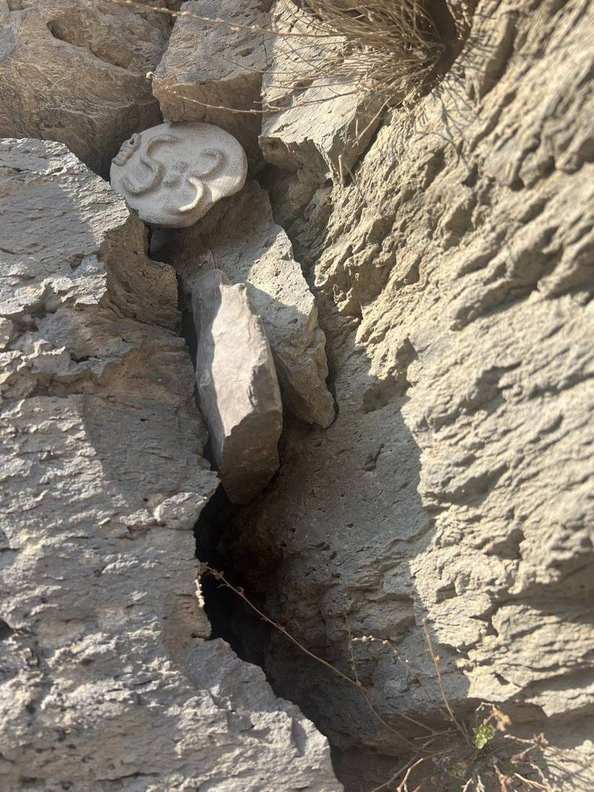
In April 2025, a friend placed a 5=3 plaque in Yerevan on my behalf. I was not there, and neither of us realized until later that the wall already had something on it — a mural by a Colombian street artist who had visited Armenia in 2023, tucked into a spot where our plaque ended up covering part of his work.
Nobody noticed at first. The plaque looked fine where it sat, and it was only when I looked closely at the photos afterward that I recognized the edges of another piece underneath and around it. That is a specific kind of dread for anyone working in public space: realizing that something you left behind with good intentions might have quietly erased part of someone else's.
Finding the Artist
I did not have a name to start from, only the mural itself. I ran a reverse image search on the parts of the artwork that were still visible, which eventually led me to an old news article covering the artist's visit to Armenia back in 2023. From there I could put a name to the work and, eventually, find a way to reach him directly.
I messaged him, explained what had happened, and asked whether the placement was a problem. He said it was fine. That answer mattered, but it did not undo the fact that a friend, carrying my plaque with the best intentions, had put it somewhere it did not belong without either of us knowing the wall already carried someone else's name on it, in the loosest sense.
Good intentions do not give you the right to write over someone else's work.
This is the lesson I want other people doing similar things to take seriously: never place a plaque, a poster, or a sticker on top of an existing piece of street art, mural, or memorial, even by accident, even when the space looks abandoned or half-forgotten. Street art has its own etiquette, built up over decades by people who take the same risks we do — working in public, without permission, hoping their work is respected by whoever comes after them. Placing something on top of another artist's piece breaks that etiquette regardless of intent, and the fact that this artist was generous about it does not mean the next one will be, or should have to be.
Since Yerevan, the rule for anyone carrying a plaque on the project's behalf is simple and non-negotiable: check the wall first. Blank space, weathered stone, an unused surface — yes. Anything that already carries someone else's work, no matter how faded or partial, is off limits. It is a small rule, but it is the kind of rule that only gets sharper after you have broken it once by accident and had to go looking for the person you might have wronged. It is the same care that now guides friends carrying plaques through a week of stops across northern Germany or through a quieter placement, borrowed glue and all, in Basel.
Armenia later got a second piece, placed with far more care — a plaque set among the basalt columns of the Symphony of Stones — proof that the same country could hold both the mistake and what came after it. I think about that Yerevan wall often, not because anything went badly in the end, but because it could have. The project exists to make space for a conversation that has been silenced for too long — it would be a strange kind of failure to do that by silencing, even accidentally, another artist's voice on the same wall.
Your numbers matter too
Write down your own X = Y in solidarity, download the free stickers, or ask us to send a plaque to your city.
Share your numbers