The first time the project reached Armenia, in April 2025, it happened almost by accident. A friend placed a plaque in Yerevan and, without realizing it at the time, ended up covering part of an existing mural by a Colombian street artist who had visited the country back in 2023. I only found out once photos started circulating — I did a reverse image search, found an old news article about the original mural, tracked the artist down, and messaged him directly. He was understanding about it, but the incident taught me something I now treat as a hard rule for the whole project: never place a piece on top of someone else's existing work, no matter how empty a wall looks.
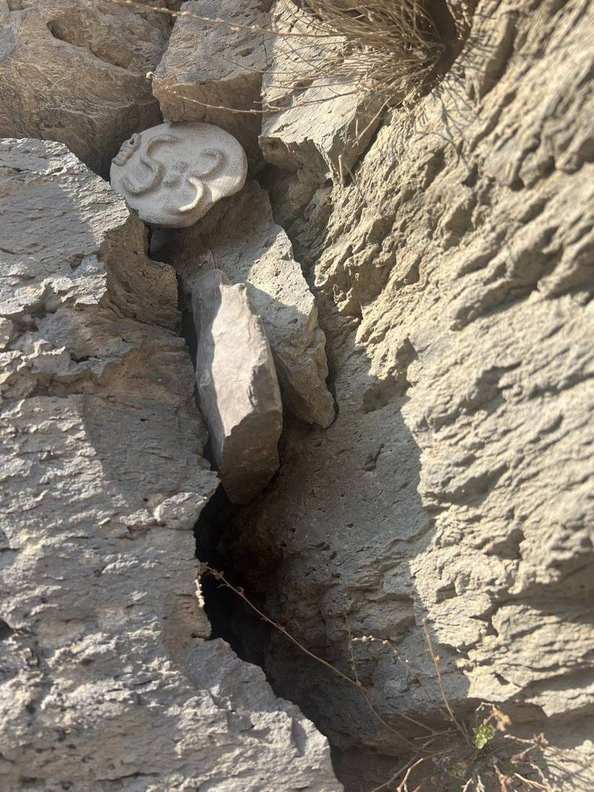
So when Armenia came up again, for a second plaque in November 2025, I wanted the placement to be more considered — not just careful about whose wall we were using, but actually built with intention rather than improvised on the spot. That's how the second Yerevan piece ended up somewhere very different from a city street: at the Symphony of Stones, a real basalt-column rock formation near the village of Garni, outside Yerevan, where volcanic activity millions of years ago left tall, naturally hexagonal columns standing in tight, almost musical rows.
Turning a plaque into a small piece of land art
Two friends, Matrokhina and Marina Nikitushkina, were the ones who actually arranged this piece — not simply propping a plaque against a rock the way you might lean something against a wall, but building a small, deliberate land-art setting around it, using the columns themselves as a kind of natural architecture. The formation already has its own geometry, its own rhythm of vertical lines repeating across the rock face. Placing the 5=3 formula inside that setting, rather than beside a road or on a building, changed what the piece was doing. It stopped being street art that happens to intersect with a passerby's day, and became something closer to a monument set inside a landscape that had been forming, patiently, for far longer than any human story could account for.
Placed among stones that took millions of years to form, the formula suddenly looked less like a wound and more like a fact of nature.
There's something in that pairing — a formula built from personal loss, set inside a geological formation shaped by forces that have nothing to do with human timescales — that felt right in a way I hadn't planned for in advance. The Symphony of Stones exists regardless of who visits it or what anyone brings there. It was there before this project and it will be there after. Setting a small ceramic piece into that landscape, rather than onto a building someone else owns or a wall someone else maintains, meant the plaque could exist without needing anyone's ongoing permission to remain standing. It's the same instinct that later pulled me back to Georgia, the country most tied to my own loss, for a second, quieter visit — letting a place hold something I'd been carrying alone.
What the accident in Yerevan actually taught. I think about the first Yerevan plaque and the second one as a kind of before-and-after for how the project treats space. The first taught me, uncomfortably, that a wall that looks empty to a traveler passing through might already belong to someone else's work, someone else's years of effort, and that carelessness there causes real harm even when nobody intends it. The second showed me what's possible when placement is planned with real care from the outset — when the site itself becomes part of the piece rather than a convenient surface to attach it to.
Land art has always used landscape as more than a backdrop; it treats a place as a collaborator. The Symphony of Stones plaque is a small gesture by that standard, but it's the first time this project let a location's own character shape how a piece was made and set, rather than simply choosing a wall and moving on. I don't know yet whether more of the project will move in that direction — most plaques will probably keep going up on ordinary city walls, because that's where people actually walk past them in daily life. But Armenia showed that sometimes the right setting for a formula about loss and continuation is a formation that has already been continuing, quietly, for millions of years.
Your numbers matter too
Write down your own X = Y in solidarity, download the free stickers, or ask us to send a plaque to your city.
Share your numbers