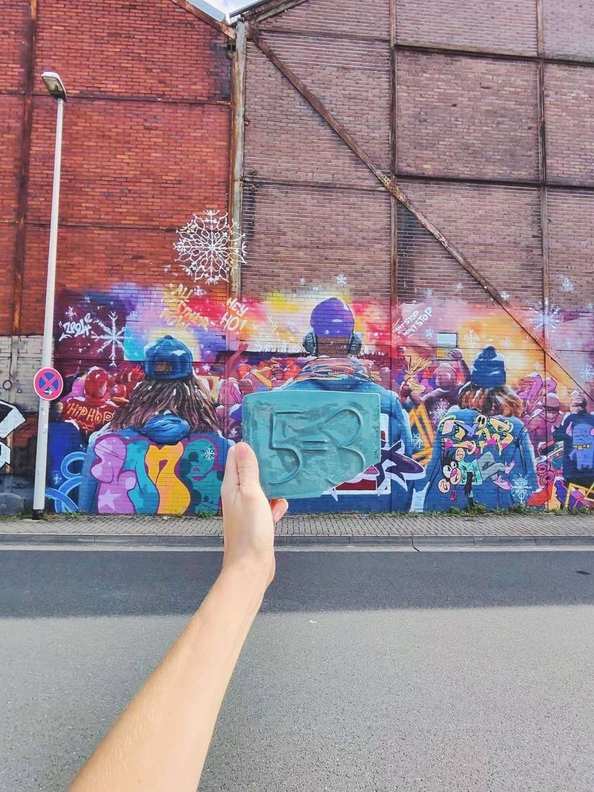
The first 5=3 plaque was not planned as an object with a manufacturing philosophy. It was a shard — hand-cut, glazed, imperfect at the edges — that Anna Maslennikov's husband carried to Paris in May 2024 and left on a wall with no explanation, just the formula and a QR code. Nobody sat down beforehand to decide what a plaque "should" be made of. The material was ceramic because ceramic was what was on hand, what could be shaped quickly and fired hard enough to survive weather, streets, hands.
That first material choice turned out to matter more than anyone expected. Hand-cut, glazed ceramic has a specific quality: no two shards look alike, and the imperfection reads as honest rather than sloppy. A plaque with a slightly uneven edge doesn't look manufactured or promotional. It looks like something a person made, which is exactly what it is. For the plaques placed in Vienna, Georgia, and the early Israeli cities, that same rough, glazed ceramic stayed the default — cut and fired one at a time, each piece its own small object rather than a copy of a template.
When one plate becomes five
Rehovot, in March 2025, changed the math of the material without changing its spirit. A ceramic plate cracked — the kind of accident that would normally mean throwing something away — and instead of discarding it, the broken plate became five smaller plaques, each carrying its own version of the formula. That's the moment the project's relationship to material shifted from "make a plaque" to "find what a piece of ceramic can still say even after it's broken." A cracked plate turned out to be more, not less, useful than an intact one: it multiplied.
Cast porcelain arrived later, first for Madrid in June 2025, and it changes the character of a plaque considerably. Where a hand-cut shard is unrepeatable, a cast piece can be produced from a mold — smoother, more consistent, closer to something you'd find in a shop window than found on a wall. Porcelain doesn't try to look accidental. It has its own kind of honesty: a formal material, associated with china cabinets and heirlooms, carrying a formula about loss instead of a wedding date. Placing X=Y in porcelain rather than rough ceramic is its own quiet statement — that this belongs in the register of things worth keeping, not just things worth noticing.
Paper came next, and it moved the project furthest from its origins. The street poster made from real pregnancy tests, in June 2025, uses a material nobody would think to call "art supply" — a plastic-and-paper object most people only ever see alone, in a bathroom, at a moment of intense private suspense. Turning that object into a public poster does something a glazed shard can't: it puts the instrument of the question, not just the answer, on the street. It's blunter, and it was meant to be.
Every material the project has used says something different about how private a number is allowed to be.
The most recent material shift is the least precious: a free, printable sticker pack, made with an illustrator toward the end of 2025. Stickers cost nothing, need no kiln, no mold, no plate to break. Anyone can print one at home and place it themselves, which means the material question stops being about what Anna can make and starts being about what anyone can carry. Ceramic and porcelain are slow and singular; a sticker file can exist in a hundred cities in a week. Both approaches are still 5=3 — the formula doesn't change — but the sticker format finally answers a question the project had been circling since Paris: what happens when the material stops being the bottleneck.
Your numbers matter too
Write down your own X = Y in solidarity, download the free stickers, or ask us to send a plaque to your city.
Share your numbers