In June 2025 the project tried something that had nothing to do with clay. Instead of a ceramic plaque, we built a street poster out of real pregnancy tests — dozens of them, arranged and fixed into the shape of the formula, "5=3", so that from a distance it read like any other piece of urban lettering, and up close it was made of the single object most associated with the very start of a pregnancy.
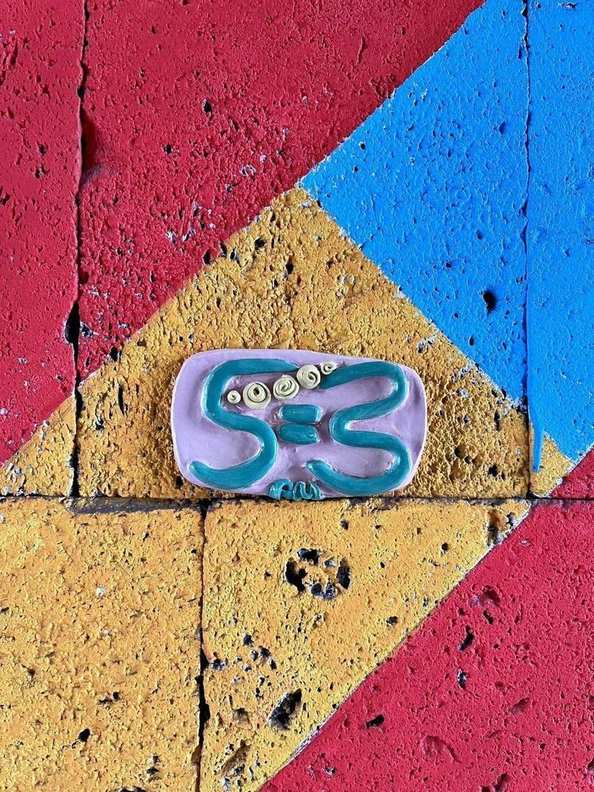
The choice of material was deliberate. A ceramic shard is beautiful, but it is also abstract — a formula on a fragment of fired clay, quiet and a little removed. A pregnancy test is not abstract to anyone who has used one. It is the object you stare at for the longest two minutes of your life, sometimes with hope, sometimes with dread, sometimes both at once. Building the numbers out of that object collapsed the distance between the art and the fact it was describing.
Why Materials Keep Changing
The 5=3 project has never stayed still on format. It started as hand-cut glazed ceramic in Paris, moved to cast porcelain within a year, and by mid-2025 had also become a large street poster and, later, a set of free printable stickers. Each material asks something different of the viewer. Ceramic invites someone to crouch down and read something small on a wall they might otherwise walk past. A poster made of pregnancy tests works at the scale of a billboard — it stops people who were not looking for anything, because the material itself is instantly recognizable before the message is even parsed.
Making it was less like ceramics and more like assembly work: sourcing enough tests, working out how to mount them so the piece would hold together and survive weather and handling, then finding a wall where the poster could exist as street art rather than as something roped off in a gallery. That last part mattered most. The whole project depends on being encountered rather than sought out — someone walking to work, not someone visiting an exhibition.
The material had to be something people already understood before they read a single word.
The formula stayed exactly the same as it always is: X for the number of times pregnant, Y for the number of children raised. What changed was the surface it was written on. Where the ceramic pieces ask for a quiet, close reading, the pregnancy-test poster works almost as a provocation — it takes an object usually encountered alone, in a bathroom, in silence, and puts it in public, at scale, where it cannot be quietly put away in a drawer.
Reactions to it were more immediate than to any ceramic plaque. People photographed it, argued about it, asked what it meant before they had worked it out themselves. That is different from a plaque, which usually gets discovered rather than confronted. Both approaches matter. Quiet pieces reach people who are already looking inward; a poster like this reaches people who were not thinking about pregnancy loss at all until they turned a corner.
It remains the boldest material experiment in the project so far, and it will not be the last. The formula is fixed. Nothing else about how we choose to say it in public is.
Your numbers matter too
Write down your own X = Y in solidarity, download the free stickers, or ask us to send a plaque to your city.
Share your numbers