Before there was a single ceramic plaque anywhere in the world, 5=3 existed only as a formula in a caption. Anna Maslennikov had already been public, in a limited way, about her own five pregnancies and three children — the arithmetic was something she'd said out loud before, in the way people sometimes do on social media, testing whether a private fact can survive being said in front of an audience. It survived. What came next is the part that's easy to forget now that the project spans two dozen cities: for a while, 5=3 was just words on a screen, not an object anyone could walk past.
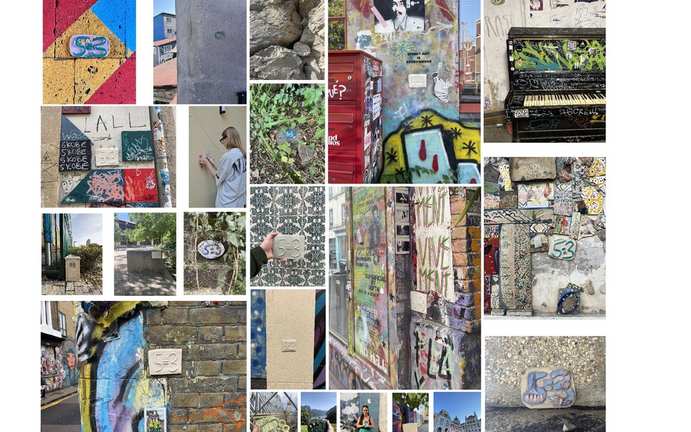
The move from caption to street happened in May 2024, in Paris, when a single hand-cut, glazed ceramic shard — no explanation, just the formula and a QR code — was placed quietly on a wall by Anna's husband. That gap, between an Instagram post and a physical object bolted or glued to real stone in a real city, is where the project actually became what it is now. A caption can be scrolled past in under a second. A plaque on a wall has to be walked past, and walking past something is a slower, more physical kind of encounter than reading a feed.
Why the street does something a feed can't
An Instagram post reaches people who already follow the account, already know something about Anna, already have some context for what "5=3" might mean. A plaque on a wall in Vienna, or Georgia, or Yerevan, reaches somebody with zero context — a person walking to work, waiting for a bus, killing ten minutes before a train — who has never heard of the project and has no reason to expect anything meaningful on that particular stretch of wall. That stranger's confusion, that brief moment of "what is this," is worth more to the project than a thousand people scrolling past a post who already understand the reference. The street produces first encounters that social media, by its nature, mostly can't.
A caption can be scrolled past. A plaque has to be walked past.
None of this makes Instagram irrelevant — quite the opposite. The account is still how most people learn a plaque exists at all before or after they've seen one, and it's the thing that turns a solo installation in one city into a project other people recognize when they travel somewhere else and spot the formula again. The QR code on every plaque exists specifically to route a street encounter back into the online space where the fuller story lives. The two aren't in competition. The feed explains; the street interrupts. Each does something the other can't.
Twenty-some countries later, the project has kept both halves of that original move. Every new city — Lisbon, Basel, Bremen, wherever comes next — still starts as a plan discussed online and ends as an object in a physical location that a stranger has to actually encounter. The formula hasn't changed since that first Instagram caption. What's changed is the delivery mechanism: from a sentence you could like and forget, to a small fired object that sits on a wall whether or not anyone ever likes it at all.
Your numbers matter too
Write down your own X = Y in solidarity, download the free stickers, or ask us to send a plaque to your city.
Share your numbers