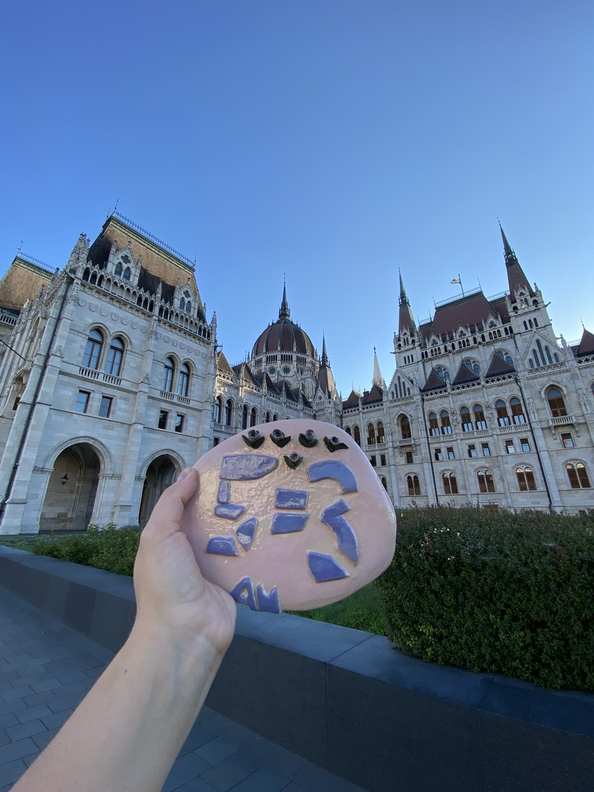
Most people who encounter a 5=3 plaque do exactly one thing with it: they take a photograph, maybe scan the QR code, and keep walking. That's completely fine — the project was built to work at that scale, a single quiet moment on an ordinary street. But for anyone who wants to do more than notice, there are real, concrete ways in, and none of them require travel, ceramics training, or even much time.
The simplest is to write down your own numbers. X = Y, where X is how many times you were pregnant and Y is how many children you're raising — for most people those numbers are equal and there's nothing more to say, but for a real minority, roughly one in four pregnancies by the figures this project works from, they aren't. You don't need a ceramic plaque to do this. A note on your phone, a line in a journal, a sentence said out loud to one other person, all count. The formula was never trademarked to a material. It's a way of naming something plainly, and naming it is often the hardest and most useful part.
Beyond your own equation
Second, download the free stickers. They exist precisely so that participation doesn't depend on Anna personally making an object and personally traveling to a city. A printable sticker pack, produced with an illustrator, means anyone with a printer and a bit of nerve can put a version of 5=3 somewhere in their own town — a lamppost, a noticeboard, a wall that could use one honest thing on it. It's a lower-stakes way to place something in public than a fired ceramic shard, and that's the point: the barrier to entry keeps getting lower on purpose.
Third, if you'd rather the project come to you than go looking for it yourself, you can ask for a plaque to be mailed to your city. This is how the project has grown past what one person could carry in a suitcase — friends have placed plaques on their own initiative, in cities Anna has never visited, because someone asked and someone else made it happen. If there's a wall in your city that could hold a small ceramic fact, that's a real request the project takes seriously.
Fourth, talk about it with someone who's had a loss without asking them to perform grief for you. A huge amount of what 5=3 does isn't installation-based at all — it's just modeling that the subject can be mentioned in an ordinary conversation, at an ordinary volume, without turning into a crisis. If you know someone whose X is bigger than their Y, you don't need a plaque to bring it up. You can just ask how they're doing with it, and mean it.
Involvement was never meant to require travel. It requires being willing to say a number out loud.
Fifth — and this one costs nothing and takes thirty seconds — follow along and share what you see. The project spreads city to city partly because people who find a plaque photograph it and post it, which is how someone two countries away learns the format exists and decides to use it for their own numbers. You don't have to make anything or place anything to be part of that chain. You just have to not let the moment end the second you walk past it.
Your numbers matter too
Write down your own X = Y in solidarity, download the free stickers, or ask us to send a plaque to your city.
Share your numbers